SED group
Research group · Product development

SystemsEngineeringDesign

We study the product development process and its participants in order to understand their problems and needs — and turn that knowledge into better work procedures, development methods and computer-based tools.

Explore our publications
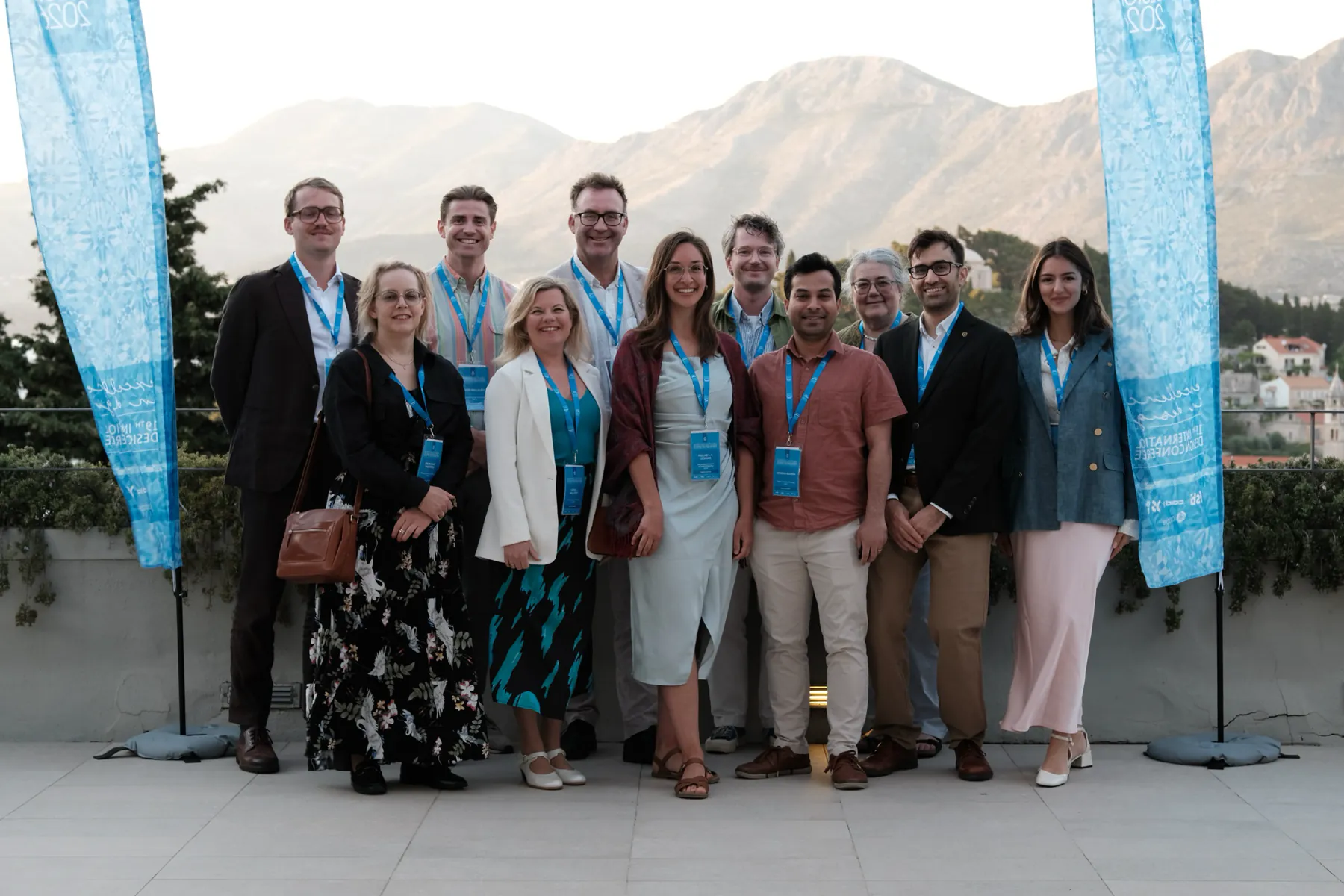
Group members working together around a table with laptops and sketches

Our values

Excellence We hold our research to the highest standards of scientific rigour and craft.Transparent method, hard internal review, and findings that hold up in real engineering practice — not just in a paper.
Open research Our publications, data and tools are free for anyone to read, reuse and build on.Green open access for every paper, openly licensed datasets, and research tools you can run straight in the browser.
Inclusiveness We build a group where every background, discipline and career stage belongs.Many perspectives in the room, and early-career researchers treated as full members of the team from day one.
Real-world impact We do research that changes how products are actually designed in industry.Questions grounded in real engineering problems, with methods and tools fed straight back into practice.
Curiosity We follow hard questions across disciplines, wherever they lead.At ease between engineering, computation and sustainability, and unafraid to cross boundaries to find better answers.

How our research is organised

Systems Modelling

We model, design and optimise the behaviour of multi-technological systems and their impact — from early function models to automated, computational design space exploration.

Team lead — Arindam Brahma

Systems Engineering

We develop resilient systems and the engineering processes behind them — requirements, architecture and lifecycle management that keep complex products consistent from concept to production.

Team lead — Dag Henrik Bergsjö

Sustainable Product Development

We integrate and implement strategic sustainability in early product design — criteria, risk assessment and decision support that bring socio-ecological responsibility into everyday engineering.

Team lead — Sophie Isaksson Hallstedt

Recent publications

All publications
2026

Capability needs for sustainable product development in aerospace: A systematic literature review

Léonard PLY, Hallstedt SI, Dokter G · Sustainable Production and Consumption · DOI ·

Carbon emissions of the aviation sector are expected to double by 2050 and there is an urgent need to change the approach to product and system design to enable a sustainability transition. Through a systematic literature review, this paper analyses 51 studies and provides a comprehensive overview of the current state of sustainable product development in the design of aircraft systems and sub-systems. A taxonomy of challenges across six categories is proposed, ranging from socio-ecological issues, regulations, economic context, design process, cognitive barriers and technological limitations. This taxonomy supports in clarifying the nature of problems practitioners may encounter when implementing sustainable product development. While aerospace companies face systemic challenges, this study argues that they can overcome structural, human and technical barriers. But to overcome this, sustainable product development capabilities need to be developed, which this study maps across product development phases and organisational levels. Fourteen aerospace-tailored support methods are reviewed through the lens of these capabilities, showing gaps in enabling cross-functional communication, managing trade-offs systematically, and mitigating sustainability risks. This study advances the Sustainable Product Development field by offering a sector-specific synthesis of challenges, capabilities and support methods in aerospace. The findings align with broader sustainability literature and provide a foundation for future cross-sectoral research and methodological development. Together, these contributions support aerospace practitioners in navigating sustainable product development challenges, develop critical capabilities, and calls for further research to accelerate sustainability integration in product development.

2026

Digital twin for supporting decision-making and stakeholder collaboration in urban decarbonization processes. A participatory development in Gothenburg

Maiullari D, Nageli C, Rudena A, Isacson Å, Dokter G, Ellenbroek I, Wallbaum H, Thuvander L · Environment and Planning B Urban Analytics and City Science · DOI ·

City Digital Twins have emerged as pivotal tools for representing and modelling urban systems. While existing literature emphasizes technological and framework development, limited attention has been given to the practical usability of digital twins in urban planning and decision-making processes. This paper addresses this gap by presenting a participatory approach for a city digital twin (CDTE) development, specifically tailored for supporting stakeholder communication and decision-making in the urban energy transition domain. The study, conducted in three phases, utilizes participatory methods, involving local stakeholders in the development process. The focus is on the Swedish city of Gothenburg, which is actively pursuing climate-neutral goals by 2030. The research integrates quantitative energy modelling and the creation of a web-based interface for the CDTE. The scenarios, grounded in local needs and challenges, explore the impacts of urban development models, climate warming and renovation measures on the building stock. The CDTE, developed and tested through workshops with diverse stakeholders, proves to be effective for the visualization and the discussion of various decarbonization scenarios. Key findings from users’ assessments underscore the significance of clarity and readability in scenario content and user interface for fostering interactions among different administrative spheres. This research contributes to the broader discourse on leveraging City Digital Twins for informed decision-making in urban contexts, providing insights into the practical application of digital twins in addressing the complex challenges of urban energy transition.

2026

Product Dataset Platform: System-Level Design Evaluation Using Data Engineering and Functional Modeling, A Crashworthiness Case Study

Arjomandi Rad M, Martinsson Bonde J, Isaksson O, Panarotto M, Wärmefjord K, Malmqvist J · Journal of Mechanical Design · DOI ·

Design space exploration at early and system-level phases often relies on low-fidelity, qualitative evaluations due to the prohibitive cost of high-precision methods. This research proposes an approach to bridge this gap by utilizing artificial intelligence (AI) and modeling tools and leveraging existing datasets and detail-level analysis to enhance system-level decision-making. Creating a platform of datasets is suggested by shared features for a product model hierarchy that mirrors the functional decomposition of the product architecture. This is achieved by integrating function mean (FM) as an early design modeling tool with an assembly of datasets acquired from finite element (FE) as a higher fidelity concept evaluation tool. This is an effort to link the early functional space to the later response space. It is shown that training prediction models on datasets from low-level product architecture, which are more viable to obtain, enables design concept evaluation at the system level. Moreover, by introducing a modular and radical change into product architecture, which represents new technologies that require performance evaluation, the built dataset platform is investigated. Finally, a metric to evaluate the platform’s success is suggested to increase reliability. As lower levels of product architecture often experience more frequent changes than system-wide modifications. This method can be effective in scenarios where component-level innovations require rapid performance evaluations. The implications of such a dataset platform can reduce the concept evaluation cost in early phases by accelerating the testing of innovations and ideas in product architecture.

2026

A risk analysis method for implementation of additive manufacturing

Brahma A, Hajali T, Mallalieu A, Isaksson O · Journal of Engineering Design · DOI

2026

Co-evolution of design research and industrial development: empirical insights from European manufacturing companies

Eckert C, Isaksson O · Journal of Engineering Design · DOI ·

While many studies have analysed societal and technological trends, what these imply for product development practice is less clear. However, engineering design research has typically responded to existing challenges in industrial practice, instead of looking forwards to create tools and methods in parallel with technological developments. This paper reports on the findings of a three-stage process with 12 interviews and two workshops, in 2018 with ca 50 participants and 2021 with ca 100 participants. Experienced engineers working on complex engineering products and engineering design researchers reflected on developments in engineering, which were analysed from the perspective of how they would affect design practice. The paper summarises trends the participants identified in manufacturing, energy, transport, digitisation, product design and product development practice; and highlights differences in expectation between 2018 and 2021, in particular around the speed in which sustainability policies and changes to work practice are adopted. The paper analyses the interaction of trends, pointing to the increasing interaction of products with each other and with services, and the implications of the rapid advances in digitalisation, which increase the need for disciplinary integration. The paper ends with a discussion of research questions arising from the analysis in this paper.

News

All news