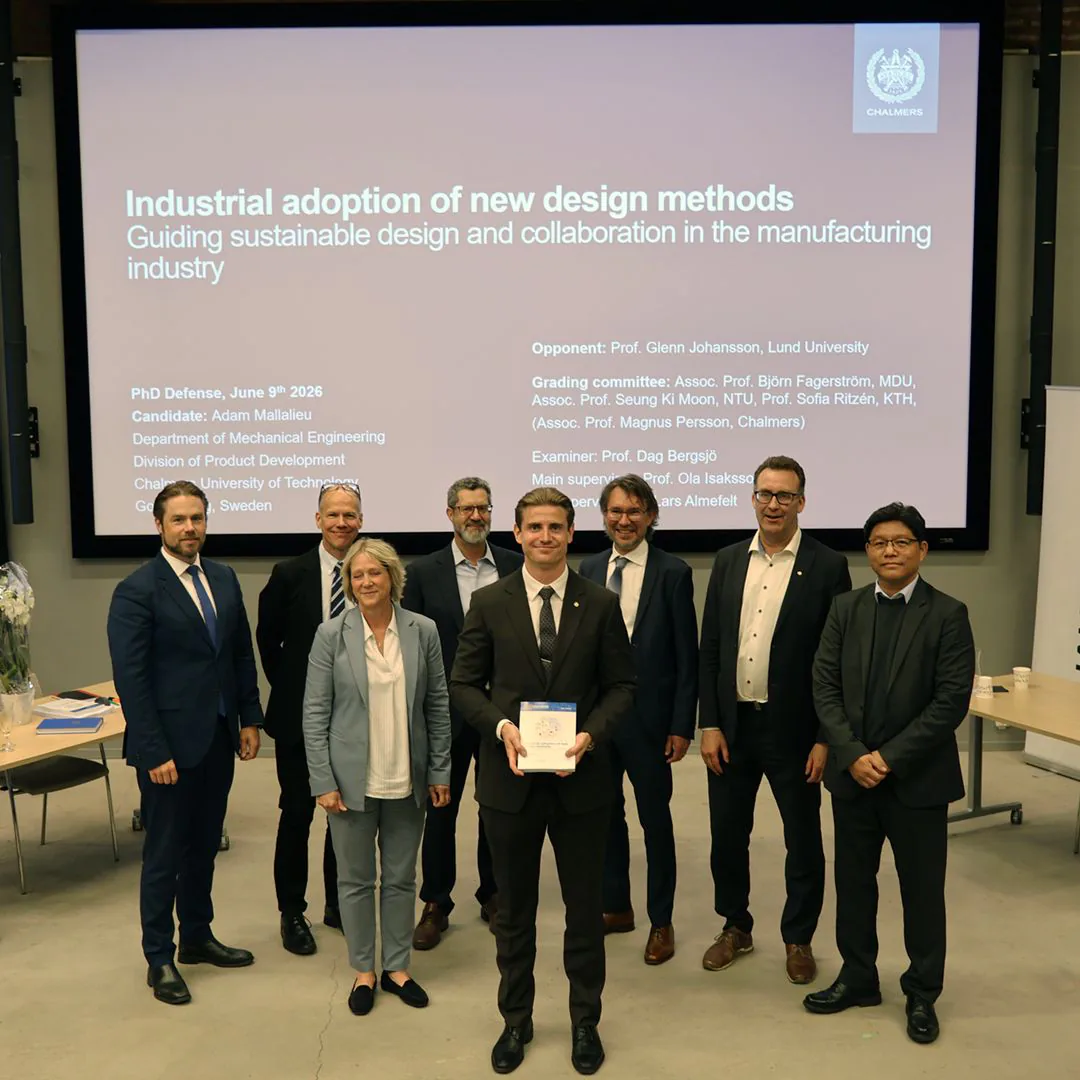
We congratulate Adam Mallalieu on a successful PhD defence!
The thesis is titled “Industrial adoption of design methods: guiding sustainable design and collaboration in the manufacturing industry”.
We thank the opponent, Prof. Glenn Johansson (Lund University), and the grading committee: Assoc. Prof. Seung Ki Moon (Nanyang Technological University, Singapore), Prof. Sofia Ritzén (KTH Royal Institute of Technology), and Prof. Björn Fagerström (Mälardalen University).
Main supervisor: Prof. Ola Isaksson (Product Development). Co-supervisor: Dr. Lars Almefelt (Product Development). Examiner: Prof. Dag Bergsjö (Product Development).
Abstract
The manufacturing industry needs a rapid shift in how products are designed and produced to better contribute to sustainable production and consumption. This, together with emerging technologies, upcoming legislation, and changing market trends, drives a sustainability transition in manufacturing companies, and design has been identified as a crucial enabler of this transition. Therefore, design researchers have proposed several design methods to support adequate integration of sustainability in their design processes. Despite their evidenced benefits, the industrial adoption of such design methods remains underutilized, an issue that has persisted and been continuously raised for more than 20 years in the design domain. This research adopts an interdisciplinary perspective to study industrial adoption, employing several methods to collect and analyze qualitative empirical data together with actors in the Swedish manufacturing industry, including action research, case studies, participant observation, Glaserian grounded theory, questionnaires, and interviews.
There are four main contributions of this research: (i) a descriptive framework that captures 53 interdisciplinary barriers and enablers to the industrial adoption of design methods, incorporating process and methodological, organizational, and human-behavioral perspectives; (ii) two new concepts, the dualism of design methods and the situational design problem, which clarify the role of design methods in a sustainability transition and the key barriers to industrial adoption; (iii) a needs-driven and collaboration-based adoption approach that guides industrial adoption by supporting researchers and practitioners to adapt design methods; and (iv) an interactive method to guide the assessment of a collaborative ecosystem's ability to share and manage sustainability information and data.