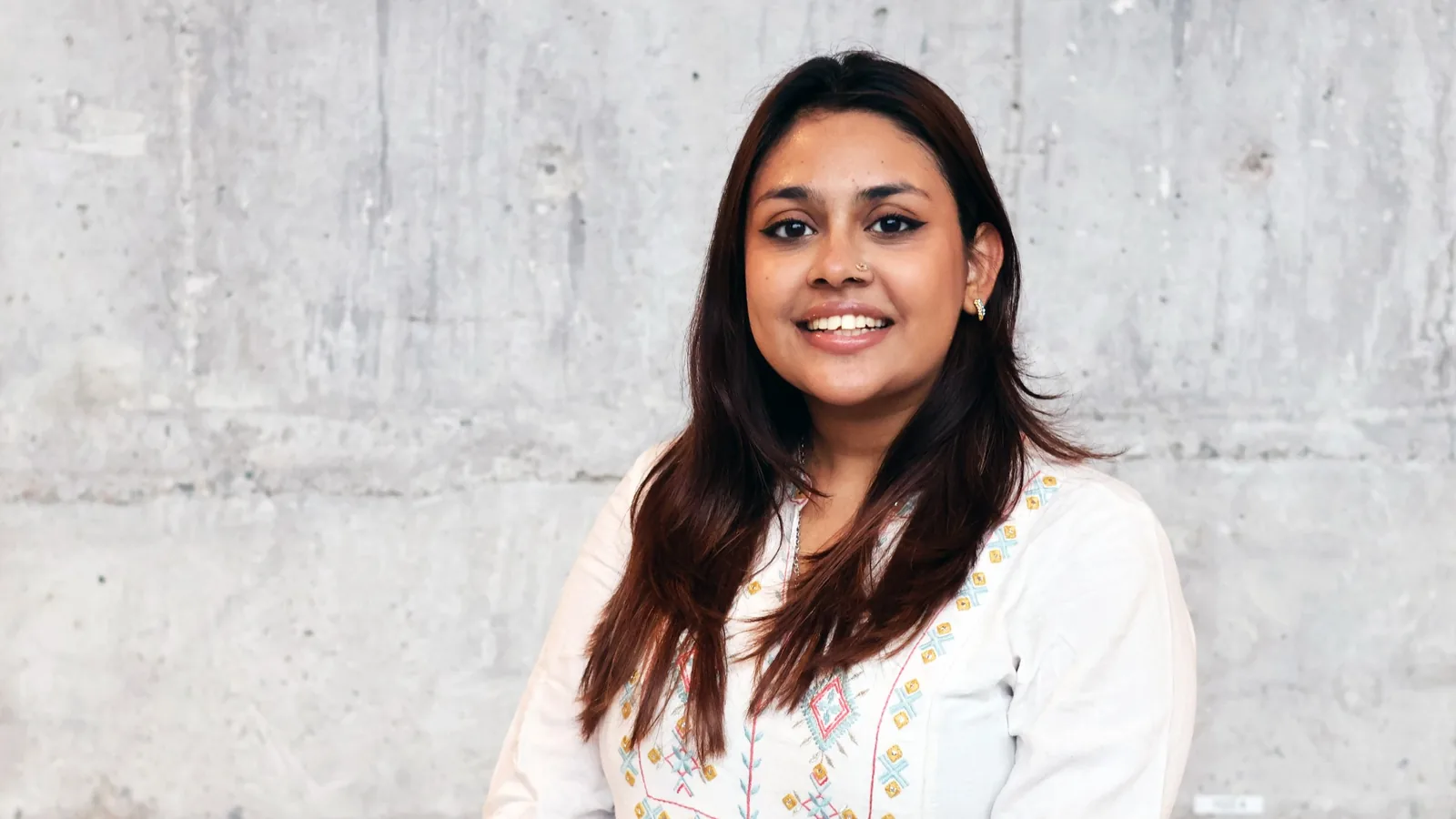
We are happy to welcome Apala Chakrabarti to the Systems Engineering Design group as a doctoral student, working on the integration of sustainability and AI in design margins. We sat down with Apala to talk about background and hobbies, the road back to Chalmers, and hopes for our research and teaching.
Tell us a little about yourself. What is your background, and do you have any hobbies you would like to share?
Hello! I’m Apala, I’m 26 and originally from India.
I’ve always been someone who asks a lot of questions and enjoys figuring things out. Growing up, my parents encouraged me to be curious and find answers for myself. I could spend days going through books just because I wanted to understand how something worked. Looking back, I think my parents probably knew I would end up being a researcher before I did!
Although, growing up, I actually wanted to become a doctor. That plan changed quite quickly when I realised I would have to study botany as well! So, I pivoted to what I thought was the next best thing: biomedical engineering.
During my bachelor’s, I got to explore research in different parts of the world, spending time in labs in Singapore, the US, Japan and India. I studied Electronics and Communication Engineering, with a specialisation in Biomedical Engineering, at Vellore Institute of Technology in India.
I then moved to Sweden to pursue my master’s at Chalmers University of Technology. I became interested in how AI could be used to support medical image analysis, which eventually became the subject of my master’s thesis.
After graduating, I moved back to India. I wanted to take a step back, try something different and explore where else my interests could take me. I joined the Centre of Excellence in Design at the Indian Institute of Science as a Technical Lead. It was quite an interesting shift from biomedical engineering, and I got introduced to a whole new way of looking at engineering problems through design. I really enjoyed that experience, and somewhere along the way, I realised that engineering design was something I wanted to pursue further.
Outside of work, I’m a trained Odissi dancer, a form of Indian classical dance, and I’ve been learning it since I was quite young. I also enjoy writing, have a blog of my own, and love travelling. So, there’s usually something keeping me occupied!
Why did you choose to join the Systems Engineering Design group at Chalmers?
I think this is quite a fun story!
In 2025, I had the opportunity to attend the ICoRD conference in Hyderabad, India, where Prof. Hallstedt delivered a keynote on integrating sustainability considerations into the early stages of product development. I found the topic quite interesting, and I got a chance to have a short conversation with her afterwards.
What do you think about sustainability considerations in your field, medical devices? — Prof. Sophie I. Hallstedt, at ICoRD 2025
Honestly, I realised I didn’t have much of an answer to that question! It stuck with me. I went back, started reading about it, and the more I looked into it, the more I realised how much work there was to be done in this area. It made me curious about the intersection of sustainability and engineering design, and I eventually started exploring this through my own research and publications.
That initial conversation was really what set things in motion and eventually led me to apply to the Systems Engineering Design Laboratory at Chalmers. Of course, having already studied at Chalmers and lived in Gothenburg was an added bonus. I was familiar with the university and the city, so I knew settling back into the environment would be a little easier!
What are your research interests?
Unsurprisingly, I have quite a few research interests! But I’m particularly passionate about exploring sustainability, design and AI. While these are all very broad fields, I’m especially interested in how they can come together to support better decision-making in engineering design. More specifically, I want to understand how we can integrate sustainability into the early stages of product development, where decisions have long-term consequences but are often made with limited information and considerable uncertainty. I’m also interested in how AI and digital tools can help designers navigate these complexities, understand trade-offs and make more informed decisions.
What do you hope to bring to our teaching?
When I think about the courses I’ve taken throughout my education, the ones that have stayed with me the most are usually the ones that were interactive. I hope to bring that same approach to my teaching. I would like to encourage dialogue in the classroom, where students aren’t just reading or listening to course material but actively engaging with it. I think there’s a lot of value in learning by doing, experimenting with ideas and, importantly, seeing the work take shape. Being able to visualise and experience what you’re learning can make a real difference to how well you understand it. Having worked in teaching and training at IISc, I’ve also seen how differently people learn, and I’d like to create an environment where students feel comfortable asking questions, exploring ideas and learning from each other.